

Why This Is Actually Normal.
North Korea are doing something right, and it's not what you think

I don’t know how many people have seen those documentaries where Westerners go to North Korea, but they always have the same most revealing moment: a contrast in how civilisations think about their leaders.
For e.g., since 2018 I’ve rewatched Michael Palin’s journey through North Korea a few times — it’s a nice watch, tbh.
Something interesting takes place during a quiet conversation with his guide. They’re just sitting in nature together when the subject turns to political leaders and the way people speak about them.
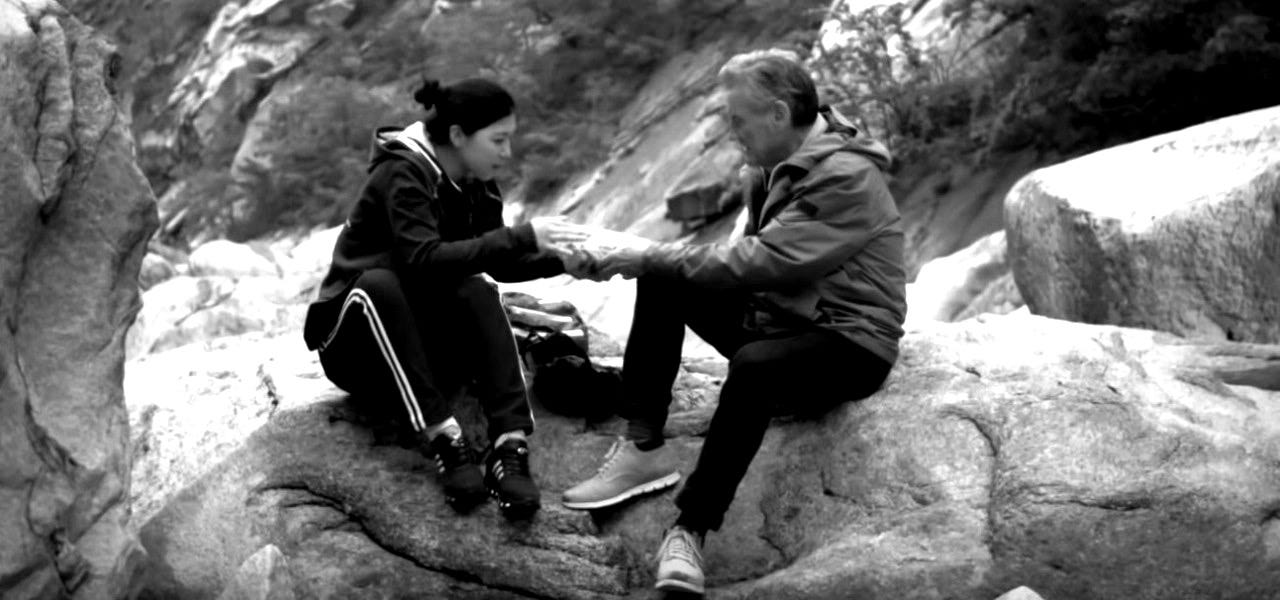
Anyway, Palin explains that Westerners are free to criticise their leaders, often harshly. His guide struggles to understand the attitude. The leaders, she tells him, “represent the people”. Meaning that they are essentially an abstraction of the people themselves into a political body, so being rude about them would amount to being rude towards yourself, your family, etc.
Palin responds as most Westerners would. He sort of sums up by saying that political leaders are just people, people who make bad decisions and occasionally some good ones. His guide seems to regard the whole idea from another world.
The conversation stays in the mind because both of them appear genuinely sincere — Palin even says that he respects how much respect they have for their leaders. But each is trying to explain something that feels obvious within their own civilisation, but neither can quite enter the other’s understanding.
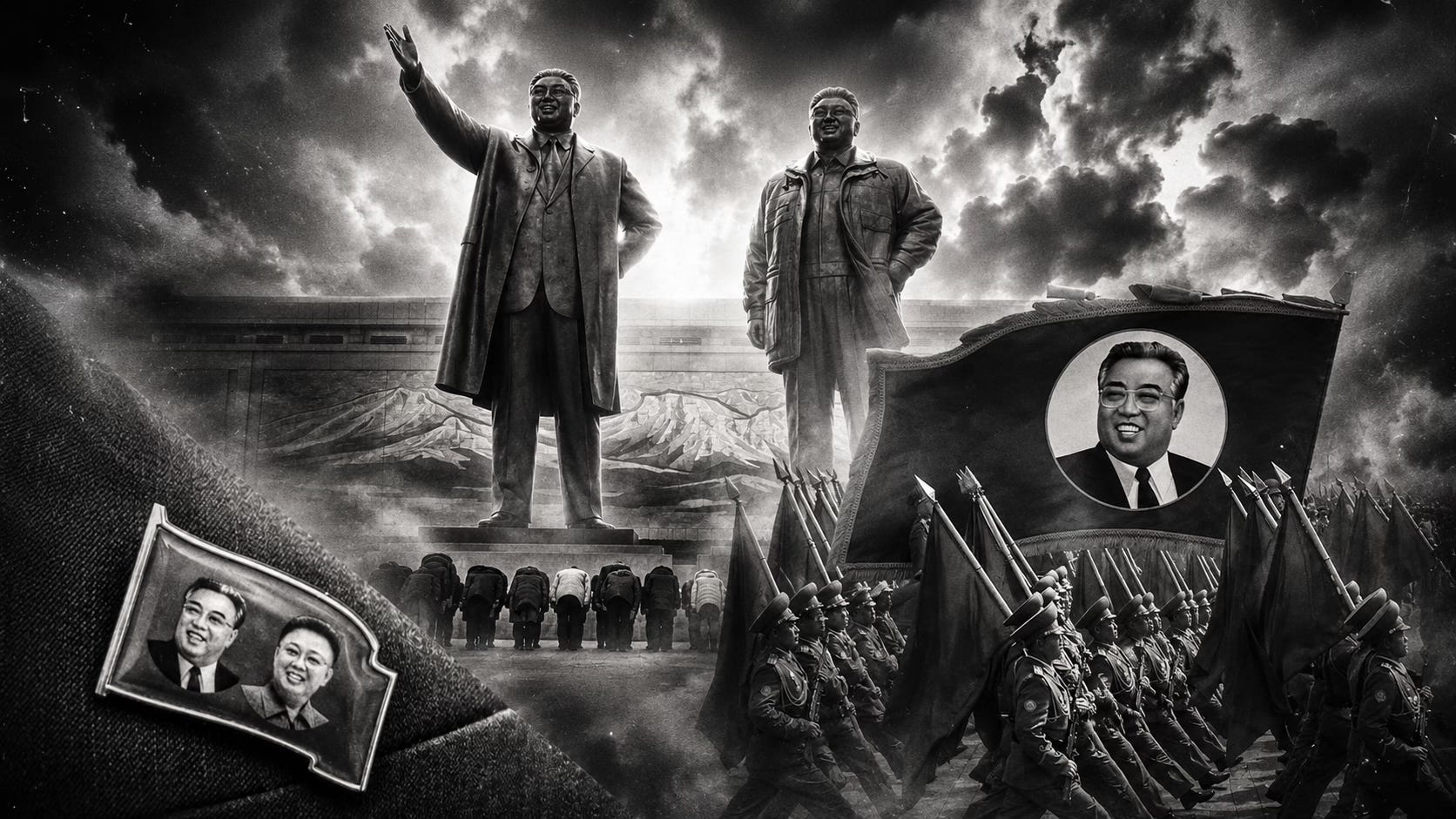
Most Western viewers will instinctively side with Palin. I certainly did when I first watched this. The woman’s reverence feels unsettling, and we assume that it’s simply enforced. The immense statues of Kim Il-sung and Kim Jong-il produce the same sort of reaction. So do the portraits, the ceremonies and the badges worn close to the heart. They are usually presented as evidence of a society that has departed from normal human behaviour.
Despite this feeling we get, the veneration of political leaders is actualally among the oldest political practices in the world. Great rulers have long been honoured as founders, fathers and ancestors. Their images have been carried through streets and placed inside temples. Their tombs have become sacred places. Their deeds have been recited long after the immediate circumstances of their lives had passed away.
North Korea’s wider political system lies outside the argument being made here btw.
I’m not vouching for their ideology, general politics and domestic or geopolitical actions. The question concerns this particular feature of public life and the relationship between the people and the state:
Is the desire to treat a great leader as an enduring presence really so unnatural?
Despite that being the most salient difference, it’s actually the most normal thing about their country.
1. A world without political reverence
Modern Western politics has gradually lost the category of reverence.
We understand the leader as an officeholder. He is appointed through a recognised procedure and given authority within established limits. He administers an existing system. The public observes his performance, examines his private conduct and waits for the next election.
This way of thinking has become so familiar that it feels like the natural form of politics. Max Weber described modern authority as increasingly rational and legal. Power belongs to the office, the rules surrounding it and the procedures that determine who may occupy it. The office continues while the individual comes and goes.
The result is a political world designed around replaceability.
A prime minister enters Downing Street (or the White House, etc) and leaves a few years later. His successor uses the same rooms and inherits the same machinery. The person may affect the direction of government, although the office is expected to remain greater than its holder.
This shapes the emotional range of political life: A politician may be respected for his competence or disliked for his decisions, and he may become popular enough to inspire affection, but genuine reverence sits outside the accepted language of public life. Anything close to that is seen as cultish and instantly mocked.
That’s because the very idea makes many people uncomfortable. Reverence appears to threaten independent judgement. It suggests a surrender of the critical mind. The mature citizen is expected to remain sceptical, especially when confronted by authority.
Over time, scepticism becomes more than a safeguard. It’s actually a complete attitude towards the political world. Leaders are treated as inherently ridiculous. Every public figure is reduced to gossip, private weakness, and temporary popularity. Any claim to greatness is met with an urge to expose the ordinary person underneath.
This is the world Michael Palin carries into his conversation. For him, the leader is a human being performing a job. His guide is speaking about something larger. She understands the leader as a figure in whom the people encounter themselves.
That idea once required far less explanation.
2. The body of the people
The medieval historian Ernst Kantorowicz wrote about this idea of the king’s two bodies:
An ordinary physical body that aged and died
A political body connected to the realm's ongoing life.
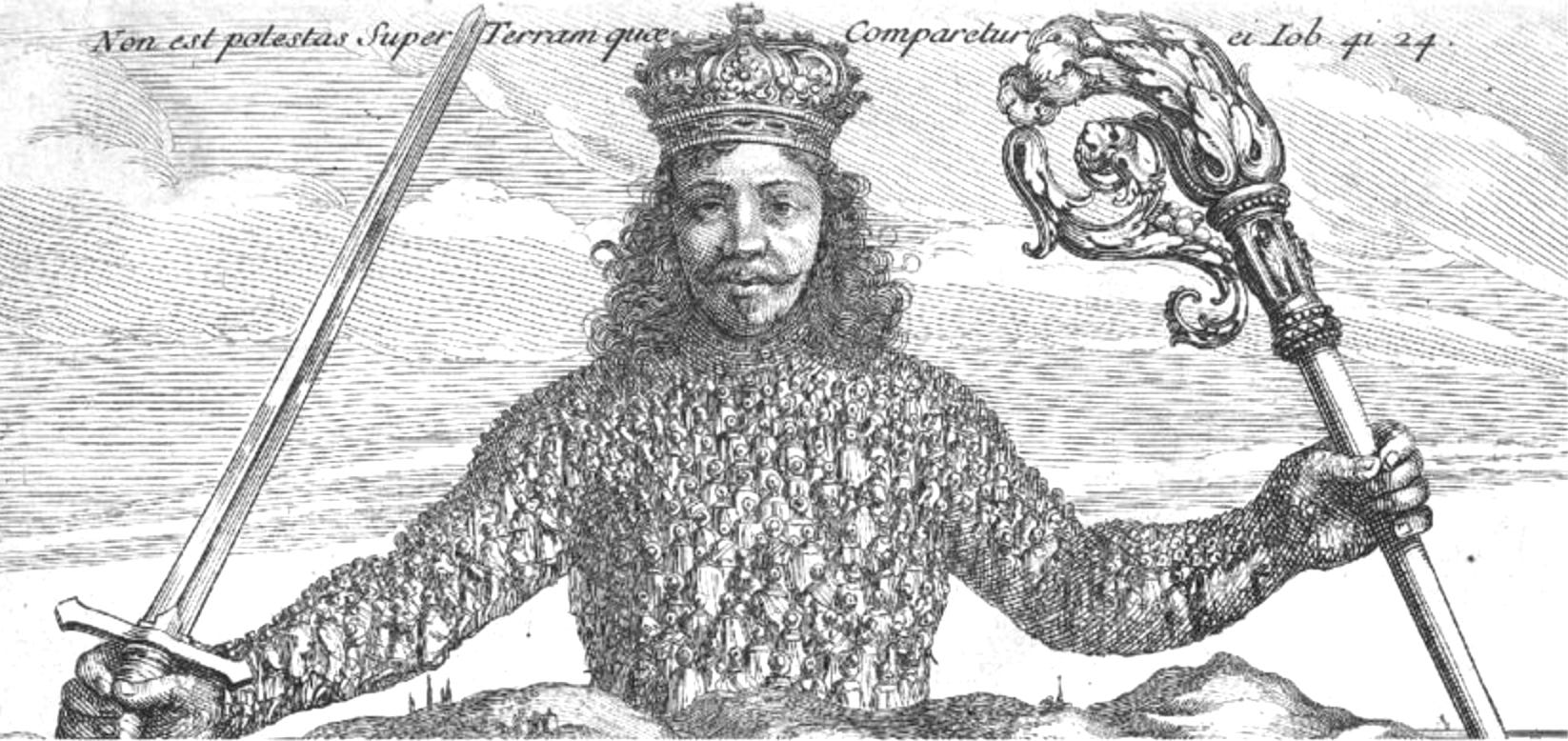
The doctrine belonged to a particular European setting, although the underlying idea appears across many political cultures. A ruler may begin life as a private person. Through office and deed, he acquires a public meaning that can no longer be reduced to his personality.
This helps to make sense of the North Korean guide’s claim that the leaders are not individuals. Taken literally, the statement sounds pretty weird, because of course the leaders were born as individuals and experienced ordinary human life. However, her words refer to their political meaning. They have become vessels through which the people understand their common history.
A leader may come to embody the founding myth of a state or its survival through war. He may represent independence from foreign power. His life becomes intertwined with an event that reshapes the existence of everyone who comes after.
Later generations do not remember such a person as they remember an able civil servant. They inherit a world that bears his imprint. Streets, borders and institutions continue to express decisions made during his lifetime. The story of the community begins to gather around his image.
Political life has always needed human forms. Abstract principles can be written down and taught, but a person gives them a face and a voice. He allows a large community of strangers to imagine itself through a single recognisable figure.
This process can happen gradually. A successful ruler becomes associated with an age of security. A founder becomes inseparable from the birth of the state. A leader who guides his people through danger may remain bound to the memory of their survival.
His private personality doesn’t vanish but is absorbed into a larger public identity.
The question of personal perfection is less important than modern people often assume. Ancestors have never been honoured because every moment of their lives would be subject to unlimited scrutiny. They are honoured because something valuable entered the world through their actions; their deeds have essentially elevated them to the position of a saint or even a god-like figure. Bear in mind, this is a phenomenon something that appears consistently across humanity in both pagan and Abrahamic spirituality.
A political leader remains human while embodying a meaning that exceeds that of the private man. His death ends his ability to act directly, but it doesn’t necessarily end his membership in the political community.
He becomes an ancestor.
3. The political ancestor
An ancestor remains present through what later generations have inherited.
Within a family, the dead continue through blood, memory and custom. Their decisions shape lives they never saw. The house they built may still shelter their descendants. The habits they established may survive without anyone remembering where they began.
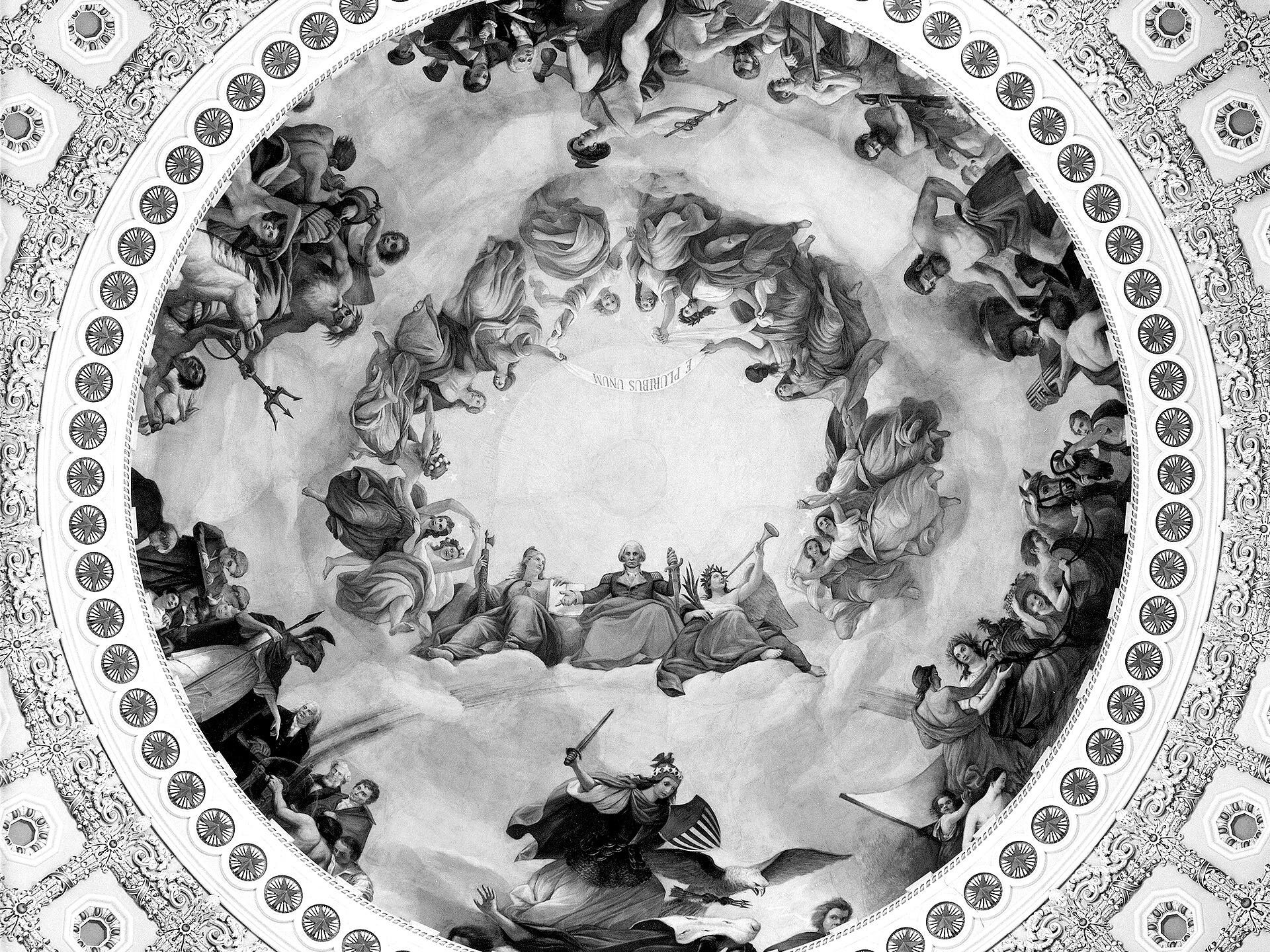
A political ancestor operates on a wider scale. His descendants include the people who inherit the common world he helped to create.
The Romans understood authority through their relationship with founders and forebears. Hannah Arendt wrote at length about the weight carried by the ancestral past in Roman political life. Authority grew from the founding of Rome and accumulated as each generation received the city from those who came before.
The ancestors remained involved in the life of the community because their acts still formed its foundations.
Something similar appears in Edmund Burke’s description of society as well; a bond extending across generations. The living are born into obligations they did not invent. They receive an inheritance from the dead and eventually pass it on.
Within this view, gratitude becomes a political emotion.
The living acknowledge that their world did not begin with them. They recognise the effort that was required to make it. Political order appears as an inheritance that carries the presence of earlier generations.
A great leader becomes a political ancestor when his deeds enter the substance of the people. He is remembered through the independence he secured or the form he gave to the state. His image begins to represent the common inheritance itself.
Korean culture already possessed deep traditions of filial reverence and ancestral remembrance. North Korean political life just placed its leaders inside a familiar moral language. Loyalty to the leader acquired the emotional character of loyalty to a parent and forebear.
This does not make the practice uniquely Korean, of course. Human societies have often understood political authority through kinship. Kings become fathers of the people. Founders become ancestors of the city. The political community begins to resemble a large household extended across time.
The dead leader then occupies a continuing place within public life. He serves as an example and a source of obligation. The living measure themselves against the world he created. His memory reminds them that they are inheritors before they are authors.
Veneration gives visible form to this relationship.
It expresses gratitude towards somebody who can no longer receive ordinary repayment. The debt is answered through remembrance, loyalty and the preservation of his place among the living.
This is why the statue always has mattered and always will.
4. The presence of the dead
The great statues of Kim Il-sung and Kim Jong-il are designed to overwhelm the person standing beneath them.
Their scale is both paramount and equivalent to their meaning. They rise above the square and command the surrounding space. Visitors approach from a distance. By the time they arrive, their bodies appear small beneath the bronze figures.
The monument turns an idea into a physical experience — A requirement for ideas that elevate the soul and touch the human being on a deeper level.
Edmund Burke associated the sublime with magnitude and power. Vast objects disturb the ordinary proportions of everyday life. They create awe by forcing the individual to feel his own limited scale.
A colossal political statue deliberately uses this response. The viewer feels the relationship through his own body. He must look up. The ancestor appears durable while generations pass beneath him.
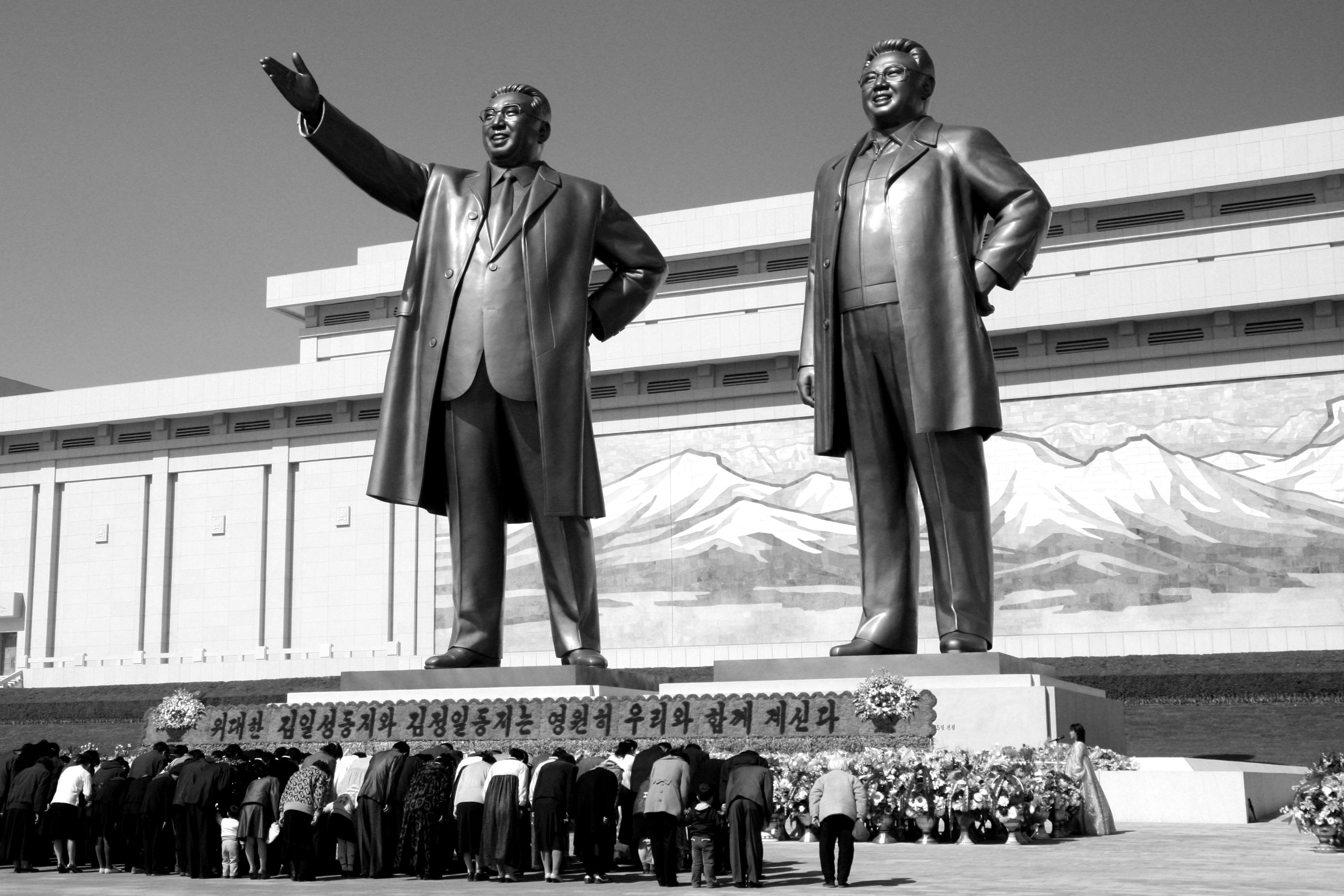
The statue allows the dead leader to remain within the state's landscape. He still occupies public space. His presence becomes part of the capital and part of the people’s image of home.
Its scale communicates the greatness of the inheritance. A modest sculpture would create a different experience. The colossus tells the visitor that he stands before something whose significance cannot be contained within ordinary human proportions.
The badges worn by North Korean citizens carry the same presence into everyday life.
The leader’s image rests on the body of the living person. It travels into homes and workplaces. The national forebear is carried through ordinary streets and appears within the smallest interactions of daily life.
The image becomes more than a portrait. It acts as a sacred symbol.
Émile Durkheim understood that communities make their collective life visible through symbols. The object receives reverence because it represents the group itself. Through honouring it, people experience their membership in a shared world.
This helps explain the emotional force of the North Korean leader image. The face represents the historical story of the state and the people formed within it. Wearing the badge becomes a declaration of belonging. It keeps the ancestor physically close.
The ceremonies surrounding the monuments deepen the same relationship. Flowers are laid, and visitors bow. Families are photographed beneath the figures. Repeated acts teach each generation how the leaders are to be remembered.
Memory rarely survives through information alone. Facts can be stored in books and archives. Living memory needs places, gestures and images. It needs habits capable of carrying emotion through time.
Modern societies often underestimate this. They build monuments that ask little from the viewer. Their public art communicates hesitation, as though any powerful expression of greatness would be embarrassing. Historical figures are surrounded by explanations until the possibility of awe has disappeared.
A civilisation that wants great deeds to remain alive must give them a form capable of reaching the emotions. Immense achievements naturally seek immense expression.
The monument's size suggests that the past retains authority, the badge says that this authority belongs within ordinary life, and together they keep the political ancestor among his people.
5. Why this is normal
A society does not need to venerate every person who holds office. The category would lose all meaning if it were granted automatically. Political ancestry must be earned through deeds that reshape the life of the people.
Once such a figure exists, the desire to preserve his presence is deeply human.
People remember the dead through objects and rituals. They carry images of parents and visit the graves of relatives. They keep heirlooms whose value comes from the hands that once touched them. Political communities express the same instinct on a larger scale.
The leader who founded or preserved the common world becomes part of the ancestry of everyone who inherits it. His statue places that ancestry within the landscape. His image allows the living to carry it with them. Public ritual renews the relationship as generations change.
The North Korean woman in Michael Palin’s documentary understands this instinct without needing to explain it philosophically. Her leaders represent the people because their public identities have become joined to the nation’s understanding of itself.
Palin’s confusion reflects our own distance from this way of thinking. We are comfortable with criticism and replacement. We have far less confidence in gratitude, reverence and inherited obligation.
For much of human history, the great leader did not simply vanish when his heart stopped beating; instead, he remained present as a founder and forebear. His people raised his image above their cities and carried his memory into the future.
There is nothing incomprehensible about that.
It is normal.
Wōden’s Kin is a reader-supported publication.
If you enjoyed this article, please consider becoming a paid subscriber or tipping me through Buy Me A Coffee.

Another great article. It seems to me that there is no more veneration for the worthy. The only true veneration we find is in trash culture, pop icons, TV stars and big business people. Unfortunately almost none of the above are venerable. If only we could find a way back to venerating the Worthy, those honest and courageous people who work/fight for the betterment of their families, their communities and their people. Thanks for writing.
Go with the Gods!
It is normal, but normal and healthy aren't the same thing. It's normal that people identify themselves woth the State, but it's also natural that people who do so tend to lose touch with right and wrong- because the State is always right.
The State itself stands in the place of God for most people, regardless of their professed religions or the officiates of their State.
I think your observation that the Nation is a political body is most keen and is a point that many do not comprehend - that it's never “them” or “they” performing crimes of State, but it's *always* “we” or “us with them.”
The leaders are no more separate from the people than a head is separate from a body, regardless of one's like or dislike of particular leaders.
Interesting piece. Thanks.